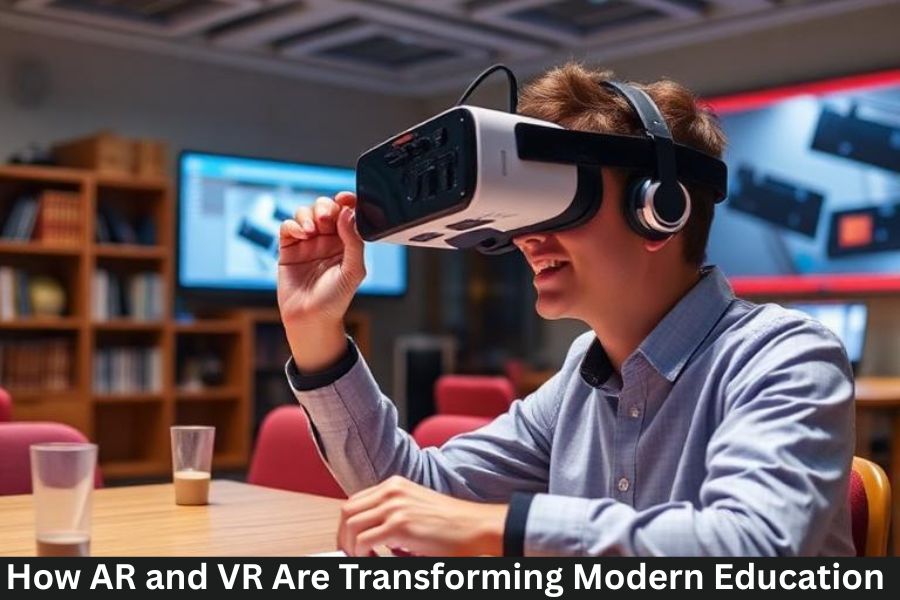
In the last few years, Augmented Reality (AR) and Virtual Reality (VR) have taken the educational world by storm. What were once just futuristic concepts have now become powerful tools, transforming how students learn and interact with the world. These technologies offer immersive experiences that traditional methods simply cannot match, opening up new possibilities for both educators and learners.
What Are AR and VR? A Quick Overview
Before diving into the benefits, it’s essential to understand what AR and VR are.
Augmented Reality (AR)
AR enhances the real world by overlaying digital information onto physical objects. Imagine holding up your phone and seeing interactive 3D models of historical figures or scientific concepts right in front of you. AR adds an extra layer of information to what you already see.
Virtual Reality (VR)
On the other hand, VR completely immerses you in a virtual world, often using a headset. In a VR classroom, students can explore far-off places like Mars or the ocean depths, experiencing environments that aren’t possible to recreate in a traditional classroom setting.
How AR and VR Are Changing the Classroom Experience
Gone are the days of merely reading about historical events or observing static images of distant lands. AR and VR are making lessons interactive, engaging, and, most importantly, memorable.
Immersive Learning: A New Approach
With VR, students no longer have to imagine what it’s like to visit the pyramids of Egypt or walk in the footsteps of dinosaurs. They can experience it firsthand. This immersive approach brings abstract concepts to life, which helps improve understanding and retention.
Hands-On Experience Without the Limitations
In traditional education, some subjects, like anatomy or physics, require hands-on experiences, but they often come with practical limitations. VR allows students to perform experiments and explore complex concepts in a virtual space without needing physical resources or risk factors.
The Impact of AR and VR on Student Engagement
Engagement is one of the biggest challenges in modern education. Students often struggle with boredom, and teaching methods can feel outdated. AR and VR are changing this narrative.
Gamification of Learning
The ability to turn lessons into interactive games or quests has proven incredibly effective. Gamified learning creates a sense of adventure and rewards, motivating students to push through challenges in ways traditional methods simply can’t.
Encouraging Active Participation
Rather than being passive recipients of information, students using AR and VR actively participate in their education. They can experiment, interact, and explore concepts in a dynamic environment, which boosts interest and critical thinking skills.
Enhancing Accessibility with AR and VR
One of the most powerful aspects of AR and VR in education is their ability to level the playing field for students with disabilities.
Bridging the Gap for Students with Disabilities
Students with visual or hearing impairments, learning disabilities, or other challenges can greatly benefit from these technologies. AR and VR offer tailored solutions, like enhanced visual or auditory cues, making it easier for students to engage with content that might otherwise be difficult to access.
Making Education More Inclusive
AR and VR open up new possibilities for diverse learning styles. Whether it’s through auditory, visual, or kinesthetic learning, these technologies allow for a more customized educational experience that can meet the needs of all students.
Case Studies: Real-World Applications of AR and VR in Education
AR in History Lessons: Walking Through Ancient Civilizations
Imagine learning about ancient Rome by actually walking through a virtual reconstruction of the city, seeing the architecture, hearing the voices of its people, and experiencing its culture firsthand. This is now possible with AR, which brings history to life in a way textbooks alone cannot.
VR in Science: Exploring the Universe
VR is revolutionizing subjects like science, where students can explore distant planets, zoom into cells, or experience natural phenomena up close. A biology student, for instance, could tour the human circulatory system in 3D, gaining a deeper understanding of how it works.
The Benefits of AR and VR for Teachers
AR and VR aren’t just beneficial for students—they also make teaching easier, more interactive, and effective.
Customizable Learning Environments
Teachers can design interactive lessons that cater to different learning paces and styles. Whether it’s a historical battle reenactment or a virtual chemistry lab, AR and VR allow educators to create dynamic environments tailored to their curriculum.
Enhanced Teaching Tools
For example, a teacher in a physics class might use VR to simulate complex forces, like gravity or magnetism, enabling students to see these forces in action rather than just reading about them. This makes abstract concepts easier to grasp.
Challenges in Integrating AR and VR into Education
While the benefits are clear, there are hurdles that must be addressed before AR and VR can be fully integrated into mainstream education.
Cost and Accessibility Barriers
AR and VR technologies can be expensive, especially when considering the cost of hardware, software, and the required infrastructure. Schools in underfunded areas may struggle to provide these resources to all students.
The Need for Training and Support
Teachers need proper training to use AR and VR tools effectively. Additionally, schools need to invest in technical support to maintain the equipment and software, which can be challenging for schools with limited resources.
The Future of AR and VR in Education
Expanding Beyond K-12: Higher Education and Beyond
While AR and VR are making waves in K-12 education, their potential in higher education is equally exciting. Virtual campuses, remote lab experiences, and immersive simulations will soon be part of everyday learning at the college and university level.
Integration with AI and Machine Learning
Looking ahead, AR and VR will likely be integrated with AI to provide more personalized learning experiences. Imagine an AI-powered VR tutor that adapts to a student’s learning style, offering targeted support based on their progress and needs.
Conclusion: Embracing AR and VR for a Smarter Future
AR and VR are not just passing trends—they are reshaping education in profound ways. By making learning more interactive, inclusive, and engaging, these technologies are preparing students for the challenges of tomorrow. The future of education is here, and it’s immersive, dynamic, and exciting.
FAQs
1. How do AR and VR differ in their use in education?
AR enhances the real world by overlaying digital elements, while VR creates fully immersive environments where users can interact with digital worlds.
2. What are the benefits of VR in science education?
VR allows students to experience science experiments and explore complex scientific concepts in an immersive environment, helping to deepen understanding.
3. Is AR suitable for all age groups?
Yes, AR can be adapted for various age groups. Younger children can engage with simple, interactive games, while older students can dive deeper into complex subjects.
4. Can AR and VR help students with disabilities?
Absolutely. AR and VR provide tools and experiences that can make learning more accessible, offering solutions for visual, auditory, and learning disabilities.
5. Are AR and VR expensive to implement in schools?
While the initial investment can be high, many schools are finding creative ways to integrate AR and VR into their classrooms, often through partnerships, grants, or shared resources.